Is Stardew Valley okay for kids?
Green light for ages 8 and up who can read fluently. Stardew Valley is the cozy game that asks more of a younger kid than parents expect, but rewards a reading-fluent one with a long, calm play arc.
Parents also ask about Stardew Valley
What age is Stardew Valley appropriate for?
8 and up for reading-fluent kids who like routine. The game's reading load is the real gate; younger kids find the menus and dialogue overwhelming. The official ESRB rating is E10+ for light combat and alcohol references.
Is multiplayer in Stardew Valley safe?
Yes, in invite-only mode. Stardew Valley multiplayer co-op uses invite codes; the host shares the code with specific friends. There are no public lobbies, no random matchmaking, and no stranger contact possible.
Does Stardew Valley have any objectionable content?
Mostly cozy. Two content notes worth knowing: the village saloon serves alcohol (the player character can drink with adult villagers, treated casually), and the romance system lets the player court adult villagers (slow, not graphic, but adult-coded play). Light combat in the optional mines.
What to watch for in Stardew Valley
- Stopping and playtimeLow
Daily-cycle structure · no streak rewards · no FOMO timers · the farm itself
- Content your child may seeLow
Saloon alcohol references · adult romance and marriage · light combat in mines
- Chat and messagesLow
Single-player has none · multiplayer chat is between invited friends only
- Contact with other playersLow
Multiplayer is invite-code only · no public lobbies · no random matchmaking
- Spending and extra purchasesLow
One-time purchase from a solo developer · free updates · no microtransactions
Before you start
The full review
Why kids want to play Stardew Valley
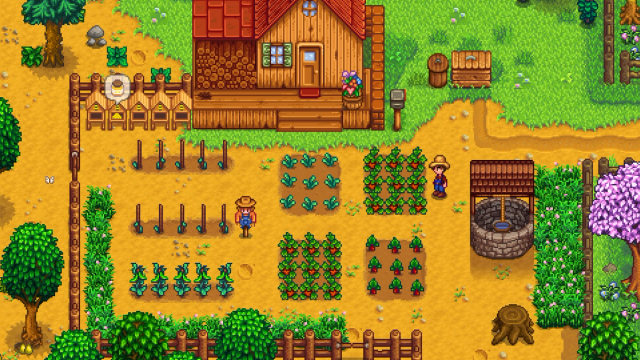
Stardew Valley is the cozy game that built a steady reputation among kids who like routine and don't want action. The pull is the slow loop: plant crops, water them, fish, mine, build relationships with the villagers, expand the farm. A kid plays for half an hour and feels like they did something even when nothing big happened.
For kids who already play Animal Crossing or Minecraft, Stardew Valley is the deeper, more text-heavy version of the cozy-game shape. For kids who don't, it can be the wall of menus that ends the cozy-game experiment before it starts. The reading floor is real and is the practical gate, more than the age rating is.
Why this verdict
- Stardew Valley is a one-time purchase from a solo developer; no microtransactions, no battle pass, no spend pressure of any kind.
- Single-player Stardew Valley involves no other players, no chat, no online element.
- Multiplayer co-op exists and uses invite codes; the host invites specific friends. No public lobbies or matchmaking with strangers.
- Content is broadly gentle: farming, fishing, cooking, building relationships with cartoon villagers. Light fantasy elements appear but nothing scary.
- Some content notes apply: light alcohol references at the village saloon, romance with adult villagers, light combat in the optional mines.
Who it fits
Best for
- Reading-fluent kids 8+ who like routine and long arcs
- Households that already play cozy games and want a deeper one
- Kids who want a calm alternative to action-driven games
Less suited to
- Younger kids who haven't hit reading fluency
- Kids looking for action or competition; Stardew Valley is intentionally slow
Detailed risk notes
- Heavy text reading required throughout
- Light alcohol references at the village saloon
- Romance and marriage system with adult villagers (the player character is presumed adult)
- Multiplayer co-op invite codes shared loosely if a kid joins online forums
- Heavy text reading
- Adult romance and marriage system (the player character is an adult)
- Light combat in the optional mines
Chat and messages
Stardew Valley has no in-game chat in single-player. In multiplayer co-op, a basic text chat opens between the players sharing a farm; it's limited to the people who joined the farm via invite code. There is no voice chat in Stardew Valley; voice happens through separate apps like Discord, which is a platform conversation, not a Stardew Valley one.
Contact with other players
Stardew Valley multiplayer co-op is invite-only. The host generates a code, shares it with specific people, and only those people can join the farm. There are no public lobbies, no random matchmaking, and no way for a stranger to find a kid's farm. The risk surface is bounded by who the kid shares invite codes with.
Spending and extra purchases
Stardew Valley has nothing to buy beyond the base game. A one-time purchase from a solo developer covers the entire game. All post-launch updates (1.4, 1.5, 1.6) have been free. There are no microtransactions, no DLC, no battle pass, no premium currency.
Stopping and playtime
Stardew Valley's pull is the slow loop, not engagement-tuned design. The game has a daily-cycle structure (each in-game day starts and ends on a real-time clock), but there are no daily challenges, no streak rewards, and no FOMO timers. The compulsion that does exist comes from the kid genuinely wanting to see the farm grow, which is a different shape than the live-service compulsion in most modern games.
Content your child may see
Stardew Valley has two content notes that distinguish it from a strict Green-light cozy game. The village saloon serves alcohol to the adult characters, including the player; a kid will see characters drinking, treated casually. The romance and marriage system lets the player court adult villagers; the play is slow and not graphic, but it is adult-coded play. Light combat in the optional mines uses simple weapons against cartoon monsters with no blood.