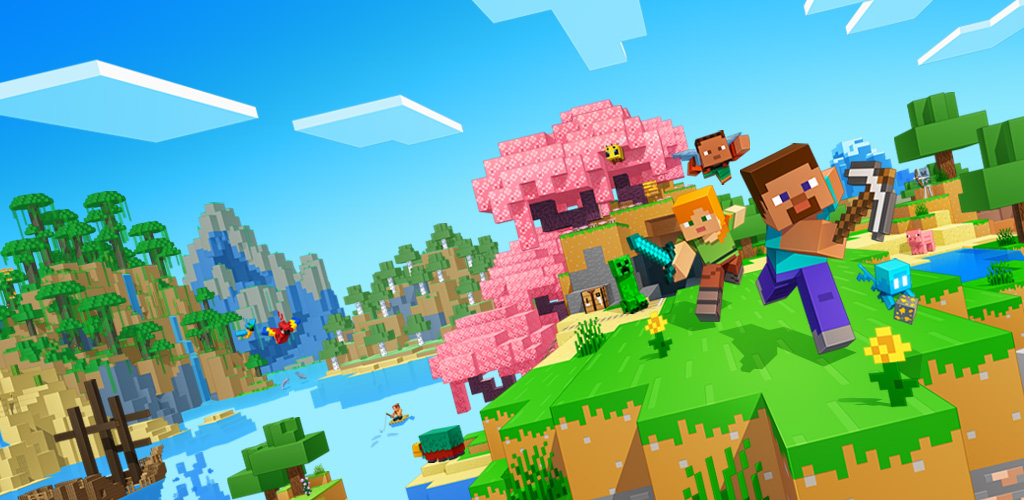
Start in Creative mode, pick Bedrock Edition, and treat the first sessions as exploration not instruction. Most of what makes Minecraft good for a young kid is the parent showing up in the world too.
Most "should my kid play Minecraft" questions get answered with a checklist. Get the Bedrock edition, set up a Realm, mind the chat settings, here are the parental controls. All useful, none of it the actual answer.
The actual answer, which keeps surfacing in parent threads written by people who have done this for years, is that Minecraft is one of the few games where the version of "playing it with your kid" you imagine before you start and the version that actually happens are roughly the same. Most kids' games are designed for the kid to play and the parent to supervise from the kitchen. Minecraft is designed in a way that makes sense for the parent to also be in there.
That changes the whole shape of how you introduce it.
I started thinking about this differently after reading a long Reddit post from a gamer-dad with two autistic sons, both grown now, who used Minecraft for nearly a decade as the ground his family met on every day. His sons were non-verbal for a long time. The communication that happened between them happened mostly through chat in the game. He gave them small tasks (build a hut, plant a few trees, count the blocks in a floor) and that was how he taught them math, biology, reading instructions, following through. By the time the boys were teenagers, he wrote, the autism was barely visible to anyone specifically looking for it. He gives Minecraft most of the credit.
My eldest is autistic, high functioning, very different profile from the boys in that story. But what stayed with me was not the specific techniques. It was the thing underneath them, which is that Minecraft is one of the only mainstream games where you can actually meet a kid in their world, on their terms, in a shared space that does not punish either of you for being different versions of yourselves. That part holds whether your kid is non-verbal at five or whether your kid is verbal but communicates in fifteen-minute monologues about redstone mechanics at nine. The technique changes, the underlying thing does not.
Most of the parenting advice on Minecraft skips that part and goes straight to the technical setup. Which is fine. But it puts the cart before the horse. The setup matters less than the decision to actually be in there too.
How to actually start (around age four to six)
Start in Creative mode. Survival is what most people picture when they think Minecraft (monsters at night, hunger, dying), and it is fun, but it adds a difficulty layer that has almost nothing to do with what makes the game work for a young kid. Creative gives them unlimited blocks, no death, and the ability to fly. For a four-year-old still figuring out the controls, removing the punishment makes everything else feel clickable.
Pick one platform and stay there for a while. Bedrock Edition (the one on consoles, phones, and Windows 10/11) is the version that works across devices and supports cross-play, which is what you want if there is any chance other family members will play. Java Edition is the original PC version, has the deepest mod ecosystem, and is not cross-platform. Most families end up on Bedrock for the same reason most families end up with whatever phone everyone else has.
Do not try to teach the controls before they start. The interface looks busy on day one and a five-year-old does not need a lecture. Let them run around in Creative for the first session or two, breaking blocks, placing blocks, flying through walls. Naming what something is called or how it works comes later, in response to a question they ask, not as a tutorial you deliver.
The structure that actually helps (around age five to seven)
Small tasks work. Not as a curriculum, not as a parent-led lesson, but as a way to give a kid a thing to do when the wide-open sandbox starts to feel like nothing in particular. The Reddit dad I mentioned earlier gave his kids tiny instructions in chat: build a hut of a specific size, plant a few of a specific tree, find six iron blocks. That structure scales. It works for an autistic kid who needs the framing to engage. It also works for a neurotypical kid who is just not sure what to do with infinite possibility.
The tasks do not need to be teaching anything for the kid to learn from them. Counting floor tiles is math without anyone calling it math. Comparing three plant types is biology without a textbook. Telling them to make a sign that says their name is a reading exercise that does not look like one. None of it lands as school, which is most of the point.
Co-play matters more than any specific task. The thing that comes through every long-form parent post about Minecraft is that the families where Minecraft "worked" are the families where the parent was actually in the world too. Not constantly. Not as a structured tutor. Just there often enough that the world is shared. A kid building a castle alone is fun for a while. A kid building a castle that their parent has also added a moat to, three nights running, is something different.
This is the part the technical guides do not really cover, because there is no setting for it. But it is the part the parents who have been doing this for years keep coming back to.
When they're ready for Survival (around six or seven)
Six or seven is roughly when Survival starts being interesting rather than scary. They can handle the night-and-monster cycle, they can manage hunger, they understand that dying happens and is recoverable rather than catastrophic. The moment to switch is usually when they ask.
If you switch, lower the difficulty first. Peaceful removes monsters entirely, which is a useful transition setting. Easy puts the monsters back at reduced damage. Normal is most people's long-term mode and is probably the right answer for a seven-year-old who has been playing Creative for a year already.
Multiplayer changes the calculus, mostly for the better. A shared family Realm (Minecraft's official paid server, runs roughly four to eight dollars a month depending on size) means the world persists when no one is logged in, and multiple family members can build in it across sessions. That is when Minecraft starts to feel like a long-running project rather than a series of sessions. Some families have the same Realm running for five or six years.
A few things to actually decide before you start
Chat. On Bedrock, chat is on by default. For a young kid playing only with family, that is fine. For a kid playing on public servers, that is a different conversation. Most families turn chat off until the kid is old enough to be on a Realm with people the parents actually know.
Mods and Marketplace add-ons. Bedrock has a Marketplace where Minecraft sells official add-ons (skins, texture packs, mini-games). Most are fine, some are surprisingly expensive, and the Marketplace is the one place where Minecraft starts to feel a bit like every other game asking for purchases. Worth setting up parental approval on purchases from the platform side (PlayStation, Xbox, Switch, Microsoft account) rather than relying on the in-game protections.
Time. Minecraft has no natural stopping point. There is no level, no boss, no end credits in the way most games end. Technically there is an Ender Dragon and credits, but a kid playing Creative will never see them, and most Survival players treat them as a checkpoint rather than an ending. That is part of what makes the game worth playing, and it is also why the time-limit conversation has to come earlier than it would for a game with a finite shape.
What about Java Edition, mods, and the deeper end
For a household with a PC-only setup and an older kid who has outgrown the basics, Java Edition is worth the switch. The mod ecosystem (the long-running ones like Create, Tinkers' Construct, Botania, plus modpacks like All the Mods or Better Minecraft) opens the game up dramatically. None of that matters for a six-year-old. It matters a lot for a ten-year-old who is starting to ask whether they can build something more complicated than the base game allows.
Custom texture packs and data packs are also a real option for families who want to bend the game toward something specific. Most parents will never need to think about either, but it is worth knowing they exist. The Reddit dad I mentioned built his own texture packs to add things he wanted his kids to read or count. Most of us will not go that far, and the game works fine without it. But the ceiling on what you can do with Minecraft as a teaching tool is genuinely as high as you want it to be.
Closing
The Reddit dad's tidy summary of his ten-year experiment was: play Minecraft with your kids and have fun. It sounds simple. Read his actual post and the simplicity hides about a decade of every-day-after-school work that made it true for his specific family.
For most families it will be much less than that. It will be a game everyone in the house ends up touching at some point, and that ends up being the place a parent and a kid have a shared world for a few years. That is not most games. Whether it has to be Minecraft specifically is harder to say. But the families who got something like that out of a video game mostly got it out of this one.
Last reviewed May 26, 2026. If your family's shape doesn't match the one this guide assumes, write back — the guide gets sharper the more households I hear from.